Feminine Hygiene Grant
To provide feminine hygiene products for female
students in need in an effort to prevent absences
and other hardship
Feminine Hygiene Grant

To provide feminine hygiene products for female
students in need in an effort to prevent absences
and other hardship
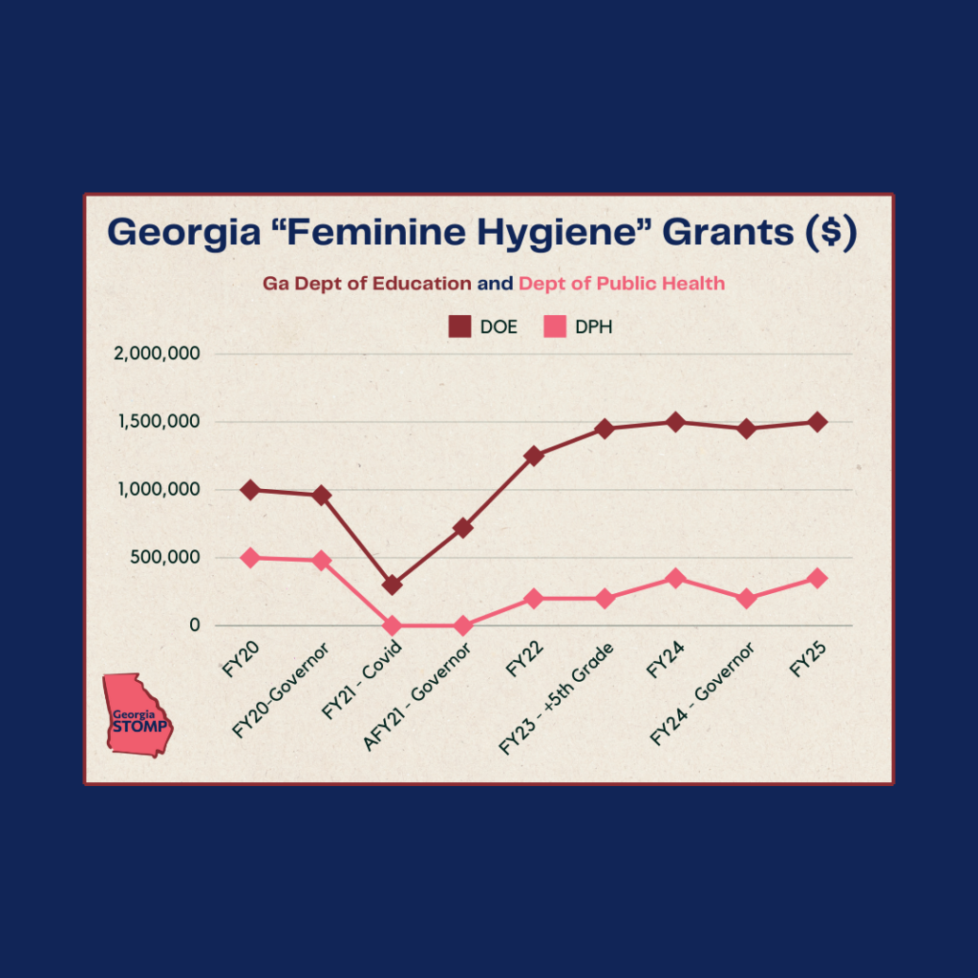

When the Georgia State Legislature adopted the budget for the state’s fiscal year 2025 (FY25), it was the sixth straight year lawmakers included funding in the state budget for the purpose of providing period products in public schools and at local county health departments. Educating legislators about the need for this funding has been a core pillar of Georgia STOMP’s work since our inception. Funding for schools insures students are in the classroom and ready to learn at their maximum potential. Period product provision via the Department of Public Health (GaDPH) enables menstruators to be present in the workplace thereby improving the state’s economy.
Currently, state funding is $1.5 M for the Georgia Department of Education (GaDOE). The funding is allocated based on the number of 5th – 12th graders at each public school in the state of Georgia. School level funding is totaled by school district and the money is relayed from GaDOE to each district. Local officials then choose whether to distribute funds to schools for school level purchasing, or period products bought in bulk and then distributed to schools.
FY25 also contains $350,000 for GaDPH to distribute menstrual discharge collection devices (MDCDs) via local county health departments. Each county health department can order MDCD’s from the GaDPH until the funding is exhausted.

This op-ed was co-authored by Georgia STOMP board member Rachel Perlis and UGA Law student Larken Cardin.
Rachel G. Perlis is a UGA Law alumna and Atlanta attorney whose practice has included litigation, state law and policy, and most recently estate planning. She serves as a Board Member and Legislative Chair for Georgia STOMP, a group advocating to expand menstrual equity and eliminate period poverty in Georgia.
Larkin Carden is a third-year law student at the University of Georgia School of Law. She graduated summa cum laude with a Bachelor of Arts Degree from Auburn University. After law school, Larkin will join King & Spalding’s Trial and Global Disputes Team in Atlanta, Georgia. Larkin is currently conducting research and analysis on the history and current treatment of the Tampon Tax in Georgia.

As the halfway point of the legislative session, Crossover Day, fast approaches, we urge legislators to prioritize legislation that would vitally impact the lives of Georgia women.
HB 123 and SB 51 are mirror bills with bi-partisan support that propose changes to O.C.G.A § 48-8-3, a portion of the Georgia code that governs sales tax exemptions.
These bills seek tax exempt status for necessary medical devices required by every Georgia woman to do basic things like go to work, go to school, and fully participate in society. That’s right, we’re talking about menstrual products, or “Menstrual Discharge Collection Devices” (MDCD’s).
Under current Georgia law, every box of tampons is subject to a 4% state sales tax. This adds about $0.32 to a $7.97 box of Tampons.
Opponents of these bills claim this extra expense is cheap, and exempting MDCDs from the state sales tax will not impact women’s wallets. Frankly, that’s not true.
The average woman spends about $20.00 on MDCDs per cycle, adding up to about $18,000 over the course of her lifetime. Because MDCDs are subject to the state sales tax, Georgia women end up paying closer to $19,000. That means the state collects almost $1,000 in revenue per woman over the course of her lifetime, solely because she has a period.
Subjecting menstrual products to sales tax is at a minimum unfair, and at a maximum discriminatory. There is no other medically necessary product purchased solely by one class of people that remains subject to the tax.
In this state, when a product rises to such a necessary level it generally warrants an exemption. Groceries fall into this category, as do prescription medications, but menstrual products continue to be taxed and Georgia women continue to suffer.
While other limited measures are in place to address lack of access to these products, such measures fail to recognize the reoccurring financial burden this tax has on Georgia women and the discriminatory nature of the tax.
Opponents claim that issuing an exemption on menstrual products will significantly impact the state’s tax revenue and overall budget. There is no denying that the revenue generated from the state sales tax is important. Sales tax constitutes the second largest single source of revenue for the state behind the state personal income tax. However, in 2023, the Georgia Department of Audits and Accounts reviewed the impact SB 51 would have on state revenue. Considering that in 2024, Georgia plans to spend $32.4 billion in money raised through taxes and fees, this report found that for fiscal year 2024, if menstrual products are exempted from the sales tax, projected revenue loss is $6.1 million from this $32 billion total. It’s hard to believe that this 0.01% loss is going to break the state budget.
Opponents tenuously argue that the issuance of this exemption will cause a snowball effect of other “special interest” exemptions, and the state’s tax revenue will diminish drastically. Let’s be clear: repealing the tax on menstrual products does not set a precedent for other tax exemptions or carve-outs. This category is singular: menstrual products are medical products that have improperly remained taxable in a state which claims to value exempting necessities.
Furthermore, concern for diminished tax revenue has not prevented the same opponents from pushing legislation that would significantly decrease overall state tax revenue, such as HB 283 (partial sales tax exemption on sale of manufactured homes), and HB 1015 and HB 1019 (respectively propose state income tax cuts and double the homestead tax exemption) which have all already crossed over from the House to the Senate. For further comparison, SB 344 (five-day tax holiday on guns, ammunition, and firearm accessories), has crossed over to the House, and would necessarily cause loss of tax revenue currently generated from these sales.
Legislators have no aversion to issuing exemptions or tax breaks. The issue is whether our legislators consider this particular exemption a priority. The fact that menstrual products remain subject to the state sales tax shows women that the 0.01% in revenue that this tax generates for the state is more important than eliminating this unfair financial burden on women.
Currently 29 states, including Florida, Louisiana, Texas, and Virginia, do not tax menstrual products. As recently as last week, an Alabama Senate Committee approved a bill that would remove its 4% sales tax from menstrual products. These states recognize this tax as unfair, and their legislative action shows women that their physical and financial health are a priority. Georgia shows no signs of doing the same.
HB 123 and SB 51 are stuck in their respective House and Senate Committees, with no indication that they will receive the requisite two hearings and a vote needed to cross over. If these bills do not move out of their respective chambers before Crossover Day, they will be dead and women will have to wait until 2025 to take this issue up again.
Leadership in both chambers should know that there are a great number of Georgians who are not happy about their lack of action to eliminate this discriminatory tax! Head here to e-mail Leadership and your state legislators to tell them you want this legislation pushed forward.
Click here to view the full article in the Georgia Recorder.
Happy New Year!
As I reflect on 2023, I am excited about the development and growth that Georgia STOMP has undergone. The team we have assembled is committed to this work. We are diverse in perspective and in the gifts we bring to the mission. For those who have been a part of this effort since its inception in 2017, you know we began as a small grassroots movement in Macon, quickly spreading to Savannah and then statewide. Not until 2021 did we formalize the coalition, seat a board and plan for a future beyond Georgia STOMP’s initial leaders. After two years of intense formational work, the future looks promising because of the team we now have in place!

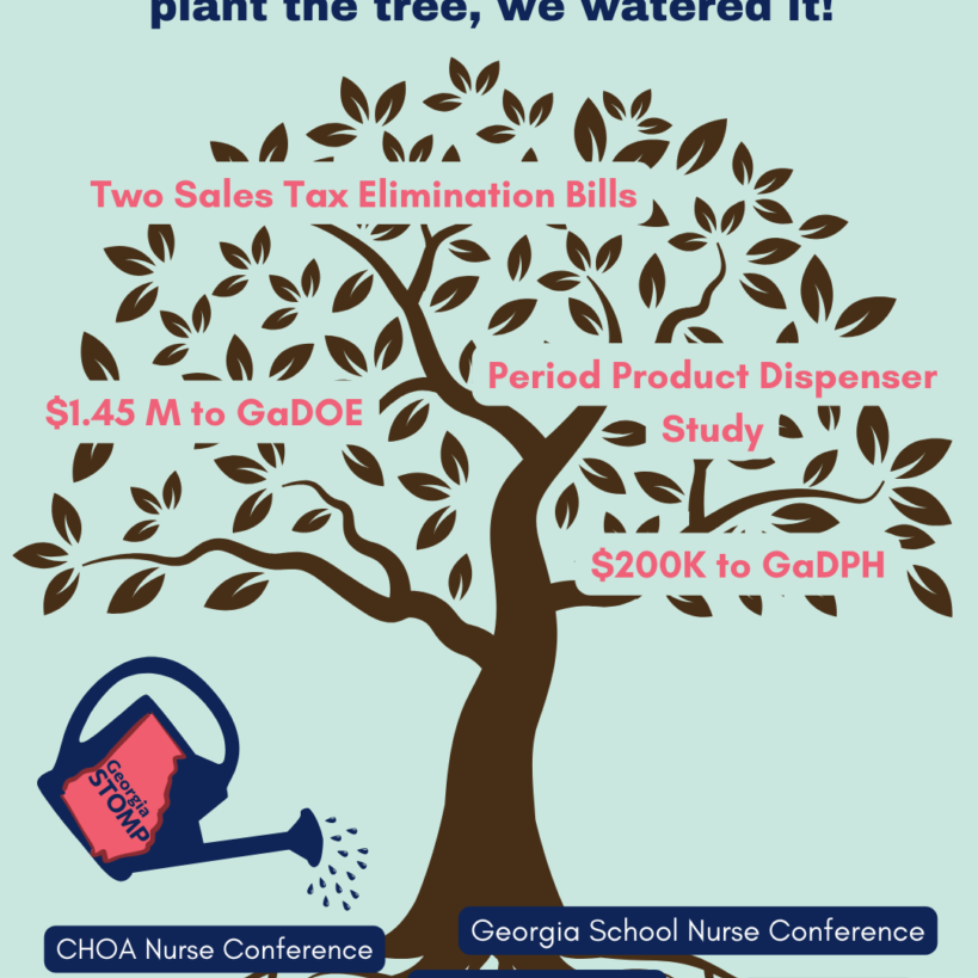
Looking back at the past few years, nothing we have done has impacted the lives of menstruators as greatly as the funding in the state budget distributed via the Georgia Department of Education (GaDOE) and the Georgia Department of Public Health (GaDPH). With the help of both Republican and Democrat leadership at the Capitol, Georgia STOMP did that! Georgia was the first state in the nation to put a line item in the state budget for period product provision. Students in Georgia’s public schools have access to period products in ways that most states have not yet realized!
Georgia STOMP works very closely with GaDOE leadership to construct the list of approved items that can be purchased with state monies, suggest best practices for distribution and train school nurses. Specifically in 2023, working closely with GaDOE and a team of researchers from Emory University led by Dr. April Ballard (PhD, MPH) and Alison Hoover (MPH), we spearheaded a project to ascertain the advisability of allowing the state “feminine hygiene grant” money to be used to install free dispensers in school bathrooms to facilitate student access. Input was received from school nurses and facility managers. The research resulted in GaDOE adding dispensers to the approved list of items that school districts can use their state allocation to purchase. Partnering with Georgia Association of School Nurses (GASN) and Children’s Hospital of Atlanta (CHOA), Georgia STOMP has been present at every major gathering of school nurses in Georgia this year. These face-to-face gatherings provide opportunities to both train nurses and receive feedback from them. This mutual education makes usage of the state funds more efficient and readies us for advocacy under the Gold Dome.

Organizationally, with a full working board seated and trained, we were able to turn our attention to committee development, thereby giving more member organization leadership a voice in the direction of the coalition’s work. Currently, committees include Communications, Legislative and Finance. If you or someone from your organization is interested in joining a committee, reply to this email and we will include you in the list for 2024-2025.
As we move into 2024, an unfinished task before us takes us back to where we began – elimination of the discriminatory sales tax! Since the inception of Georgia STOMP, the number of states that have removed the tax has more than doubled. Georgia is now one of only 21 states to assess a sales tax on products about which we have no choice, are a medical necessity and are required for good health. As 2024 begins, YOUR voice is needed in this work! MUCH too often we hear from legislators that no one in their district has contacted them about the need to eliminate the tax.
Have you called, emailed, or otherwise spoken toyour STATE Representative and STATE Senator?
Have you let your friends and relatives in various parts of the state know to do the same?
Easy Take Action links are on this website. Use them and share them with others. We provide suggested language, but he emails are also easily edited, making it possible to personalize them quickly.
As I conclude, I want to remind you that 2024 is Membership Renewal Year. Georgia STOMP has a two-year cycle for memberships and EVERY organization’s is due to renew in January. Watch your inbox for an email with links from Membership Chair, Madison Shelnutt. Reply to it immediately to make sure your organization stays connected. It will only take a moment!
Thank you for being a part of this work. Please feel free to reach out with questions or suggestions at any time! We want to hear from you. We want to work with you to make Georgia the best state for menstruators!
Claire Cox, Chair Georgia STOMP, Inc.


School doors have opened across the state which is still a shocker to some of us who never started before Labor Day! Returning to the classroom means, for many students, returning to a season of fear, facing questions like: when will my period start, will I have the products I need to attend class or after school practice and how will I ever catch up on schoolwork when I miss a week for having no pads or tampons.
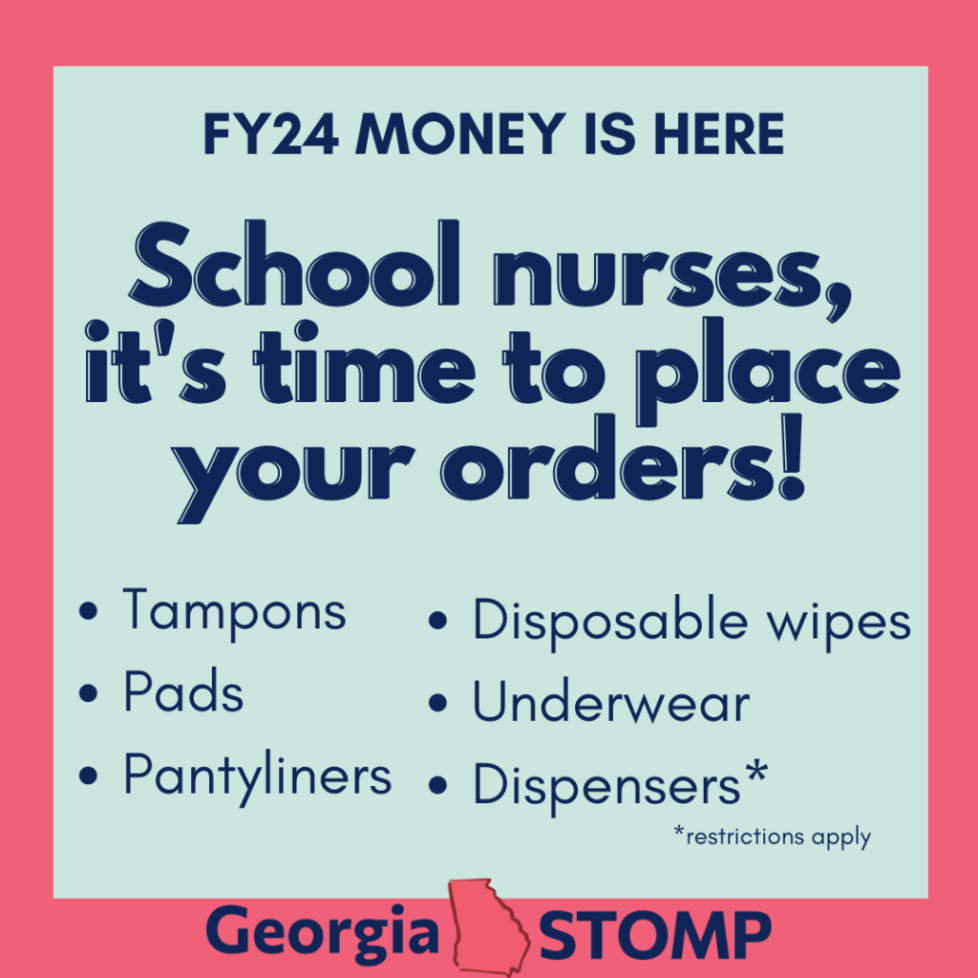
Thankfully, as a result of Georgia STOMP’s advocacy, starting in 2019, the Georgia Legislature addressed these fears, designating money in the Georgia Department of Education (GaDOE) budget for the purpose of buying period products.The State Board of Education recently approved GaDOE’s division of this school year’s $1.45M. Funds are given to schools with high poverty rates serving students in grades 5-12 and are allocated based on the number of female students in each school. The funding list by district can be found HERE.
Each year when this list is published, GaDOE also sends a list of approved products that can be purchased with the funds. The BIG news for fall of 2023 is the addition of period product dispensers to the list!

Georgia STOMP has been integral to compiling this list since the money was first distributed in 2019. Together with GaDOE leadership we have faced tough decisions about what items the money is meant to cover. The first list consisted only of pads, tampons and pantyliners. Based on feedback from school nurses, we quickly expanded the list to include disposal wipes and underwear.
Last year, multiple school systems requested approval to purchase period product dispensers for placement in restrooms. School nurses recognize that ready access to products keeps students in the classroom and eliminates the stigma of asking for this basic need. GaDOE and Georgia STOMP discussed the possibility of adding dispensers to the list; however, both were determined to use research-based data to make the decision. Concerns focused on what type of dispensers should be allowed, where they would be located, who would stock them and the required coordination with facilities management personnel or maintenance and operations (M&O) departments. Alison Hoover, MPH and April Ballard, PhD, MPH, of Georgia STOMP member organization Dignity Pack Project, graciously agreed to lead this study. Dr. Ballard’s work emphasizes translating research for public health policy into practice and, as a researcher, is an Affiliate member of Georgia STOMP.
For the past year, Dr. Ballard, Hoover and Rachel Dornfest, a student from Emory Rollins School of Public Health, interviewed school nurses, facility managers and others examining the interest, problems, benefits and pitfalls of dispensers. The overwhelming positive response was indicative of the benefits of installing dispensers.
Last week, GaDOE released the money for period products to school districts using its distribution formula. Along with their graphic, GaDOE sent a document prepared by Dr. Ballard with important guidelines, options and considerations local school systems must follow if they use state money to purchase dispensers. Among other things, the document stresses that the dispensers must distribute products for free, be installed in student bathrooms in common spaces, be purchased collaboratively with facility management and that schools should make plans for proper disposal of period products.
As with many decisions related to school management in Georgia, great variations exist between school districts, and even between schools, as to what “dispenser” might mean and how their installation and maintenance is managed. With this input and following numerous conversations with GaDOE leadership, the Ballard/Hoover team took their work a step further. They researched and prepared a document with numerous types of dispensers and strengthened it by adding links to numerous supplier websites. This document is not meant to recommend any of these options over another, but is certainly a useful tool for local school systems to employ when choosing what is the best option in serving their students.
Georgia STOMP was grateful to be the convening entity in this research and to further our partnership with the Georgia Department of Education and with school nurses. For more information, reach out to us at info@georgiastomp.org!

On Saturday, June 15, the Georgia STOMP Board met for its second Annual Meeting celebrating the first time we’ve gathered to reflect on a full year of work together! It was a joyous day with some of us meeting in person for the first time! Hugs and smiles were shared all around!
Since August of 2021, the Board has worked to transition Georgia STOMP from a grassroots effort, led for the last seven years by Adele Stewart and myself, to a sustainable and inclusive entity, governed by the Board and operating as a non-profit in the state of Georgia. We’ve had some fits and starts and quite honestly, experienced some missteps, but nevertheless made steady progress towards the goal of ensuring this work is productive and long-lived addressing the needs of menstruators in Georgia.


We are happy to welcome two new Board members — Areeba Hashmi and Sheryl-Anne Murray. Both bring experience and skills needed by the Board. Areeba has been actively involved in addressing period poverty needs among students in the Athens area and at the University of Georgia. Sheryl-Anne brings great depth of experience in the field of healthcare and a passion for community service and providing for the needs of youth. We look forward to employing their energy, knowledge and service to meet the needs of Georgians!
As a new Board with a wide range of experience in organizational leadership, it was important that we undergo training designed to empower every member of our leadership. We were fortunate to be led by Dr. Annise Mabry through a discernment process to recognize that we are a working board and as such, need opportunities to include many others in the work. Committees are the change agents necessary to expand the limited capacity of our all volunteer group. Watch your inbox soon for opportunities to join committees created on Saturday to advance the work. Your voice and your input is needed.
MANY of you have asked, “how can I be more involved in Georgia STOMP?”
Joining a committee — Communication, Finance, Legislative or Membership — is the answer to that question!
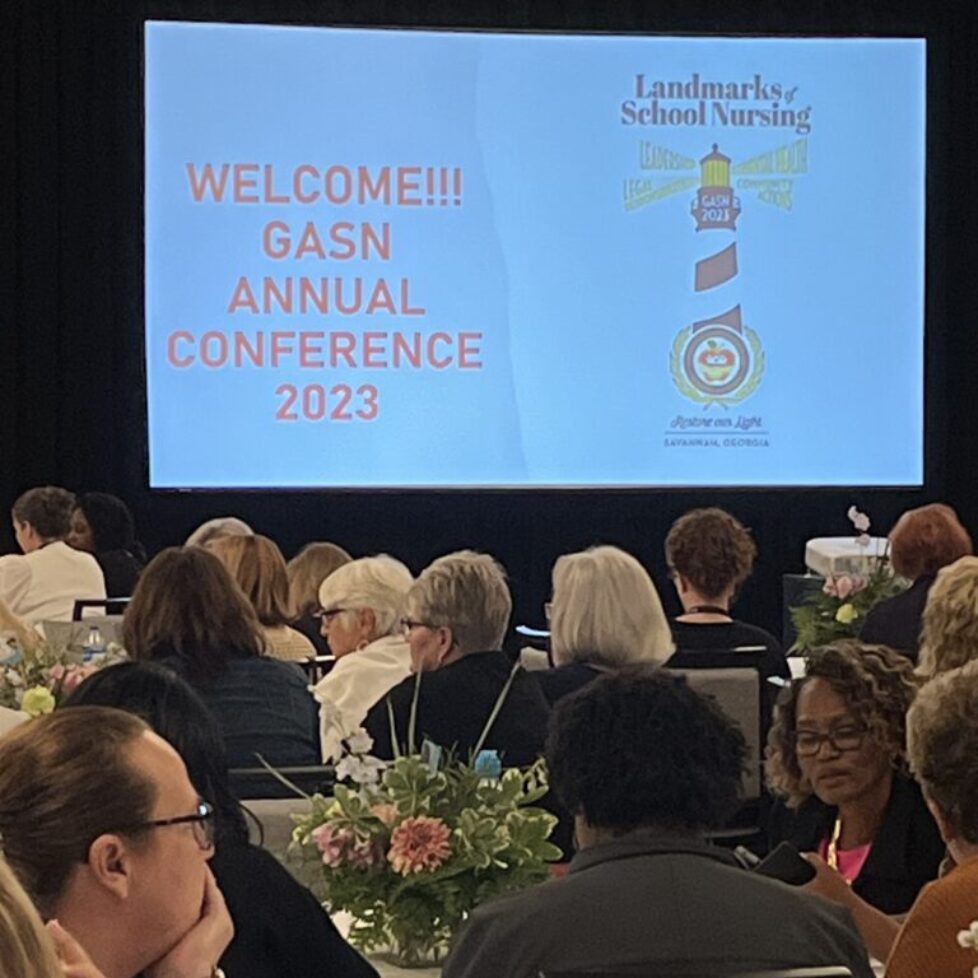


Georgia Association of School Nurses (GASN) returned to hosting their annual conference this year and Georgia STOMP was on site to enjoy the reunion! This gathering of over 350 school nurses from throughout Georgia is an important educational and connectional event for our state. The conference, held in Savannah, branded with a lighthouse and themed “Restore our Light,” was filled with a sense of excitement, friendship and a desire to hone skills and learn about new opportunities to better serve students in Georgia.
Shortly before the pandemic, GASN became a member of Georgia STOMP and plans were initiated for our participation in the conference. After waiting three years for the plan to come to fruition, we made the most of the week. We spent long hours tabling with vendors in order to talk to school nurses individually, and were grateful for the opportunity to address the gathering in a featured segment for the whole conference. The week was rich in opportunities to connect and educate school nurses about the funding available in the state budget and best practices for distributing period products in schools.
Board Chair Claire Cox spoke directly to more than 150 nurses, learning from them about the sufficiency of the state funding for period products in their schools, listening to methods of distribution that have worked (and some that haven’t) and talking to them about best practices we have learned to distribute products without shaming. Adele Stewart presented to the gathering, letting them know more about the organization behind what most Georgia school nurses call “STOMP money.” It was an opportunity to ensure each of is aware of the presence of the money, how the funds which are allocated by the legislature are divided between schools and what can be purchased with the funds. Adele concluded by inviting the nurses to reach out to us if they have any questions or need more information and to connect with us via our newsletter signup.
We wish every one of you who has been a part of Georgia STOMP throughout the past six years could have been present to hear the incredible testimonies about the difference funding is making in the lives of students and their families, and the gratitude on the part of school nurses for the assistance. Prior to the state funding, our surveys showed school nurses and other administrators paid for the products out of their own pockets almost 60% of the time!



Well designed puberty education empowers young menstruators to feel confident in their bodies. While research and curriculum development is not a direct focus of Georgia STOMP, education and knowledge around periods certainly is. Prior to the pandemic, Georgia STOMP convened three roundtables of medical professionals, legislators, Department of Education leaders and academics to discuss the state of puberty education in Georgia and brainstorm paths to improvements. Connections made through that process have continued to fuel research, inform educators and expand knowledge around the need for better tools and methods in our state.
Several Georgia STOMP organizations work to provide accurate and empowering puberty education experiences to menstruators in their area, such as Atlanta GLOW, P3 Party for Girls, Raising BeYOUtiful Butterflies, and Girls on the Run. These groups supplement the puberty curriculum provided by schools and other more traditional channels of education.
In Georgia, the Department of Education (GaDOE) sets the standards for school-based puberty education and local districts have the discretion to select resources and create instructional plans. However, the standards set by the state are vague. There is only one standard specific to puberty and it only applies to Grade 5: “HE5.1g Identify the changes that occur during puberty. Example physical changes.”
Therese McGuire, health and physical education program specialist at the Georgia Department of Education, explains that GaDOE provides professional development and content-specific training and resources to school districts. McGuire is often called upon by local school systems and teachers to share new and helpful resources and is open to hearing from Georgia STOMP members who have helpful instructional pieces or specific lesson plans to share.
Georgia STOMP recently spoke with Marni Sommer, DrPH, MSN, RN, a renowned leader in global health, researcher and professor at Columbia University Mailman School of Public Health. Sommer co-wrote A Girl’s Guide to Puberty and Periods, which includes real-life stories of menarche from adolescents and teens across the United States.
Georgia STOMP: Why is puberty education important?
Sommer: Puberty education is hugely important because it’s a phase of life when young people are experiencing so much change as their bodies develop – ranging from the more obvious physical changes to the emotional and cognitive changes to the ways in which their families, peers and the wider world start to engage with them differently socially. It’s essential that young people understand what is happening so that they can feel confident and knowledgeable about all that is happening, and not confused, scared, or anxious about the experiences. We also know that young people who feel informed and supported as they undergo the many changes of puberty are more likely to have healthier outcomes, ranging from the physical to the mental and social.
Georgia STOMP: What are 2-3 key takeaways from your research on puberty education?
Sommer: There are so many key takeaways! However if I were to narrow it down I’d say: 1) Girls across the country are still not receiving adequate practical guidance and support as they reach puberty and transition through early adolescence; 2) It’s essential to prepare girls in advance of their first period to reduce their fear and confusion at seeing menstrual blood for the first time.
Georgia STOMP: How was the Girl’s Guide developed? What differentiates it from traditional public school-based puberty education?
Sommer: We developed the Girl’s Guide after doing participatory research with girls across the country, capturing first period stories from girls in 25 states, and also interviewing parents, teachers, coaches, school nurses, and others who engage with girls as they transition into and through adolescence. To be honest, it’s unclear what “public school-based puberty education” even is across the country as many states may not be providing any puberty information or if they are, it may be limited to the biological changes happening to the body. There may also be some school districts doing a wonderful job of providing thoughtful, practical information to girls and others who menstruate in their schools. What differentiates our book, I think, and why I would love to see it in every school library across the country, is that it incorporates the real stories of adolescent girls from across the US about their first period, along with their many questions — with answers in the book – so that we both normalize the experience of puberty and all the variation in peoples’ experiences, and we also keep the book very girl-centered.
Georgia STOMP: Are there benefits to involving boys in education about menstruation/puberty for people with periods?
Sommer: Absolutely! Both girls and boys – and all young people – experience so many changes as they transition into and through adolescence and the more they understand about the others’ changing bodies, the less they are likely to tease each other, and instead will hopefully be supportive. We reduce the stigma and embarrassment. That said, sometimes young people do want to learn about such changes privately – whether it’s reading a book alone, which is our thought for the Girl’s Guide, or with other young people experiencing the same changes that they are encountering. So it’s important to provide the puberty education in a way that helps young people to feel most comfortable.
Georgia STOMP: Feel free to share anything else that I did not ask that you feel is important.
Sommer: We developed the book with appreciation for how uncomfortable many parents/caregivers are talking about these topics – and the same for girls. Our recommendation is that the books are provided to young people to read on their own, but with the encouragement to seek out trusted sources of information if they have additional questions – just as we advise in the book.
The tampon tax refers to the sales tax placed on menstrual products like pads and tampons because they are marked as a “non-essential item” (Tampon Tax, 2022). Georgia STOMP contends that the state sales tax on period products is unconstitutional based on the Equal Protection Clause of the 14th Amendment. The good news is that laws requiring people who get or have periods to pay extra for period products are falling all over the country, in red and blue states alike. A total of 28 states plus the District of Columbia have no sales tax on period products.
Twenty-three states and D.C. have eliminated the tax on menstrual products. View the list of states.


Minnesota became the first state to end the tax on menstrual products in 1981, when the state exempted all health products from its state sales tax. It took 10 years for another state to remove the tax. In 1991, Pennsylvania removed the sales tax on paper products, which included period products. A rapid influx of states eliminating the tax began in 2013, when Massachusetts declared period products medical devices and ended the tax. In the years between 2013 and 2023, 20 states have declared period products tax exempt. In 2017, Florida Governor Rick Scott (R) eliminated the tax on menstrual products as part of a $180 million tax cut package. Virginia is among the most recent states to remove the sales tax on period products, as Governor Glenn Youngkin (R) signed a bill exempting basic necessities, including period products, diapers, and adult incontinence products from Virginia’s state sales tax in July 2022. The law went into effect in January 2023.
Other states are moving toward getting rid of the tax this year as well. Notably, Texas Governor Greg Abbott announced his support for eliminating the sales tax on menstrual products. “Governor Abbott fully supports exempting feminine hygiene products from state and local sales tax,” Renae Eze, a spokesperson for the governor, told The Texas Tribune (Tampon Tax, 2022). “These are essential products for women’s health and quality of life, and the Governor looks forward to working with the legislature in the next session to remove this tax burden on Texas women.” (Melhado, 2022)
Georgia STOMP is glad that so many states have taken the step forward in recognizing this injustice, and believe that Georgia should be added to the list of states who no longer assess this discriminatory tax. Visit the Take Action page on the Georgia STOMP website to contact your legislators and express your support for eliminating the tax on menstrual products in Georgia.
References
Melhado, W. (2022, August 18). Texas Gov. Greg Abbott joins other key Republicans in supporting repealing the “tampon tax”. The Texas Tribune. https://www.texastribune.org/2022/08/18/glenn-hegar-joan-huffman-tampon-tax/
Tampon Tax. (2022, September 20). Alliance for Period Supplies. Retrieved January 30, 2023, from https://allianceforperiodsupplies.org/tampon-tax/
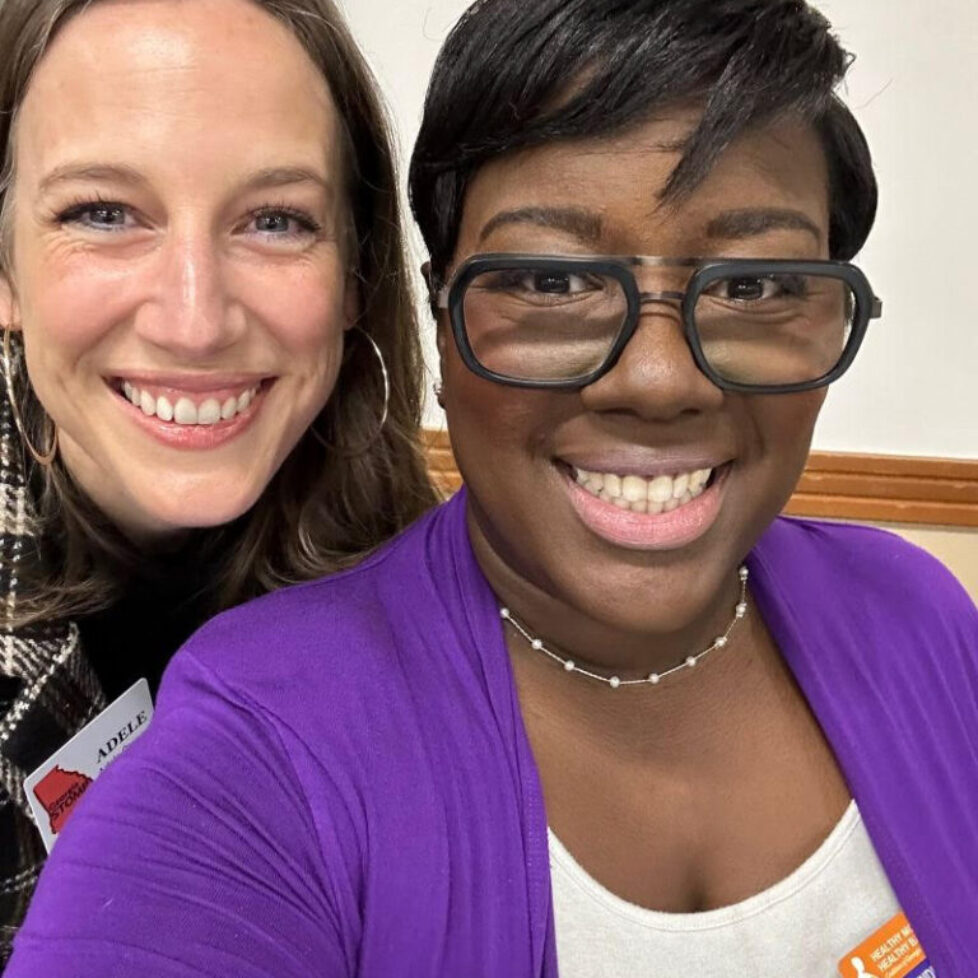
Georgia STOMP had the pleasure of speaking at the Jewish Federation of Greater Atlanta Women’s Philanthropy Project Dignity Program on January 31. Vice Chair Adele Stewart participated in a panel discussion, moderated by Dr. Mimi Zieman, with Ky Lindberg, Executive Director of Healthy Mothers Healthy Babies Coalition of Georgia (a Georgia STOMP member organization), and Elizabeth Goldberg, Chief Development Officer of CHRIS 180.
The panel engaged in a discussion about the importance of access to menstrual products, especially for those who have recently given birth or are experiencing poverty. Adele was able to highlight current advocacy opportunities related to menstrual equity and period poverty.

Adele noted, “It was an honor to have the opportunity to speak to such an engaged group of advocates and community members at the Project Dignity panel. Attendees asked such thought-provoking and empathy-centered questions – it is clear that the Women’s Philanthropy program is a group deeply committed to making the world a better, more compassionate place.”
Project Dignity is an initiative by the Jewish Federation of Greater Atlanta dedicated to providing period products to those in need, including people who are homeless, low-income, or survivors of domestic abuse. If you would like to learn more or donate to Project Dignity, please visit their website at www.jewishfederation.org/projectdignity.
