
georgiastomp
About georgiastomp
Posts by :


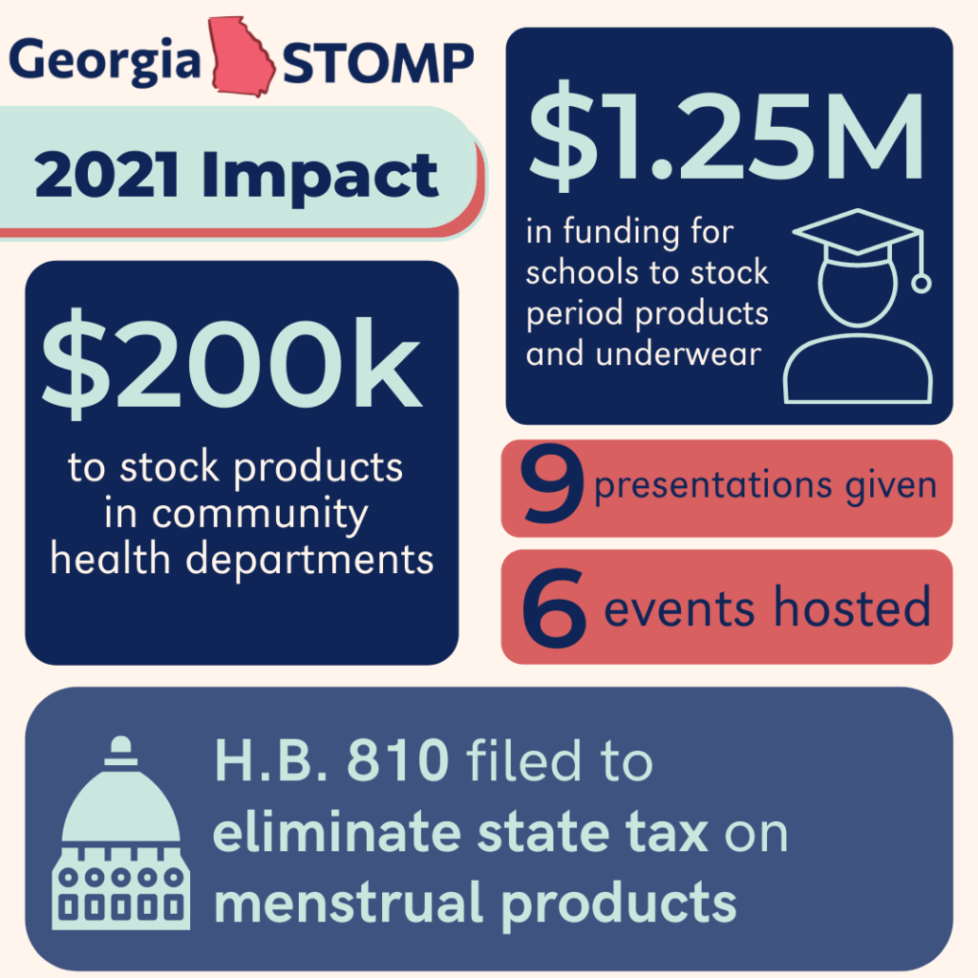
2021 Year in Review
2021 was a very successful year for Georgia STOMP! The impact of our efforts are felt throughout the state. As we prepare for 2022, it’s good to look back and celebrate the work we accomplished together as a coalition!

Educate. Advocate. Donate.
East Point/College Park Alumnae Chapter of Delta Sigma Theta Sorority, Inc. hosts the largest Georgia STOMP Candid Conversation to date!


On Saturday, December 11th, Georgia STOMP was the featured program at an event hosted by East Point/College Park Alumnae Chapter Delta Sigma Theta Sorority, Inc.
Educate. Advocate. Donate. was the theme of the day as chapter members and guests learned about the issues of period poverty and menstrual equity.
Georgia STOMP Membership Chair, Dominique Holloman, and Dr. Heather Scott of member organization, the Junior League of Douglas County, expertly conducted a Candid Conversation for over 100 virtual participants and kept them engaged and participating for the entire 1½ hours.


The virtual “All White Party” was the culmination of several months of coordinating between Georgia STOMP and EP/CP Delta chapter leadership. In November, the entire organization of Delta Sigma Theta, Inc. (DST) adopted a Resolution at its National convention Atlanta to support the elimination of sales tax on menstrual products nationwide. The event on the 11th was planned to provide DST members information on the effects of period poverty, the inequity of the tax and the existence of HB810 before the legislature in Georgia.
A Candid Conversation — normally a small intimate event — was hosted for the more than 100 in attendance. Candid Conversations are designed to break the stigma and shame associated with talking about periods equipping advocates to talk about the needs of menstruators in public conversations.
The “donate” portion of the program benefitted two Georgia STOMP member organizations — Atlanta GLOW and The Dignity Pack project. Over $1500 of period related products were donated by DST members to these two organizations who work to meet the needs of menstruators lacking period products.
The day was a complete success and the DST’s are fired up and ready to work for the passage of HB810 in the 2022 legislative session! Are you?


What You Should Know About Period Poverty in Georgia and How to Get Free Products
By Sofia Gratas, for the Atlanta Journal Constitution
Advocacy groups are working to eliminate inadequate access to menstrual hygiene tools and education.

Even though female-identifying individuals make up more than half of the state’s population, they still foot the bill for additional costs on essential health care items.
Georgia’s 4% state sales tax applies to period products, including pads, tampons, liners, cups and period underwear. There’s no male equivalent to this tax, meaning women with a typical 28-day period cycle will spend an average of $5 extra each month on tampons or pads, according to a cost calculator created by two Polish medical students.
That price tag doesn’t take into account pain medication or additional supplies women typically need during menstruation. To date, there are 28 states with some kind of sales tax on period products.
There has been some change. The Georgia Department of Corrections agreed in 2019 to ensure access of period supplies to incarcerated menstruators. That same year, Georgia lawmakers also approved a million dollar budget allocation to the Department of Education to help low-income schools afford period products for students in sixth through 12th grade.
“It’s just systemic changes that need to happen,” said Claire Cox, chair of Georgia STOMP (Stop Tax On Menstrual Products). “And they’re things that have never been talked about until this era.”
Leading advocacy groups like Georgia STOMP continue to work with partner organizations and representatives to eliminate period poverty. Period poverty is defined as inadequate access to menstrual hygiene tools and education.
Here is some essential information on where Georgia stands with period poverty, including where people can find affordable or free menstrual products in metro Atlanta.
There’s a difference between the “pink tax” and the period product tax
You may be familiar with the “pink tax.” This term refers to the upcharge in items traditionally geared toward female buyers, getting its namesake from pink packaging. It’s not an actual tax, but rather refers to a history of gender pricing.
The New York City Department of Consumer Affairs investigated this pattern six years ago, finding that “women’s products” cost 7% more than mens on average. Of the 800 identified products, those with a more than $2.30 price difference included dress shirts, hair care, some childrens toys and jeans.
Georgia charges a flat-rate sales tax of 4% on certain consumer goods, like “tangible personal property” and services. Some items are exempt, including most medical equipment, water and raw manufacturing materials. But no period products make that list.
Legislation asking for a tax exemption on period products was first introduced in 2018 as House Bill 731, which has been resubmitted every year since then with all the language intact. Cox said her team is preparing to reintroduce the same bill next year for consideration in the fiscal year 2023 budget.
“The leadership in the State House opposes this bill,” Cox said. “They understand period poverty, they believe it exists, they see the results, they hear school nurses and all talk about it. But they don’t see the equity issue of the sales tax.”
Here’s a list of programs providing free period products:
Georgia Department of Public Health
Allocation of funds from the Department of Public Health — previously cut during the pandemic but reinstated for the FY 2021 budget — ensures that local public health clinics should have period supplies on hand for people who need them.
“I want people to go and ask for (period products) because they should be there,” Cox said. “We’re working really closely with administrators at county health departments all over the state to make sure they know about it and to make sure they put them on their shelves.”
Contact: A full list of public health clinics at dph.georgia.gov/locations.
Helping Mamas
The baby supply and period product bank works with 200 agencies – including nonprofits, shelters and schools – to ensure period supplies are available to those who need them. Launched this year, Helping Mama’s mobile program also brings supplies to other areas, including libraries and apartment complexes.
The mobile program runs on a needed basis, typically around five times a month, said Demitrah Rasmussen director of volunteer and corporate relations. A program calendar at helpingmamas.org/mobile-distribution is updated every month.
Contact: Call the Helping Mama’s office at (770) 985-8010 for referrals to free products. A full list of partners can be found at helpingmamas.org/partners.
Atlanta GLOW
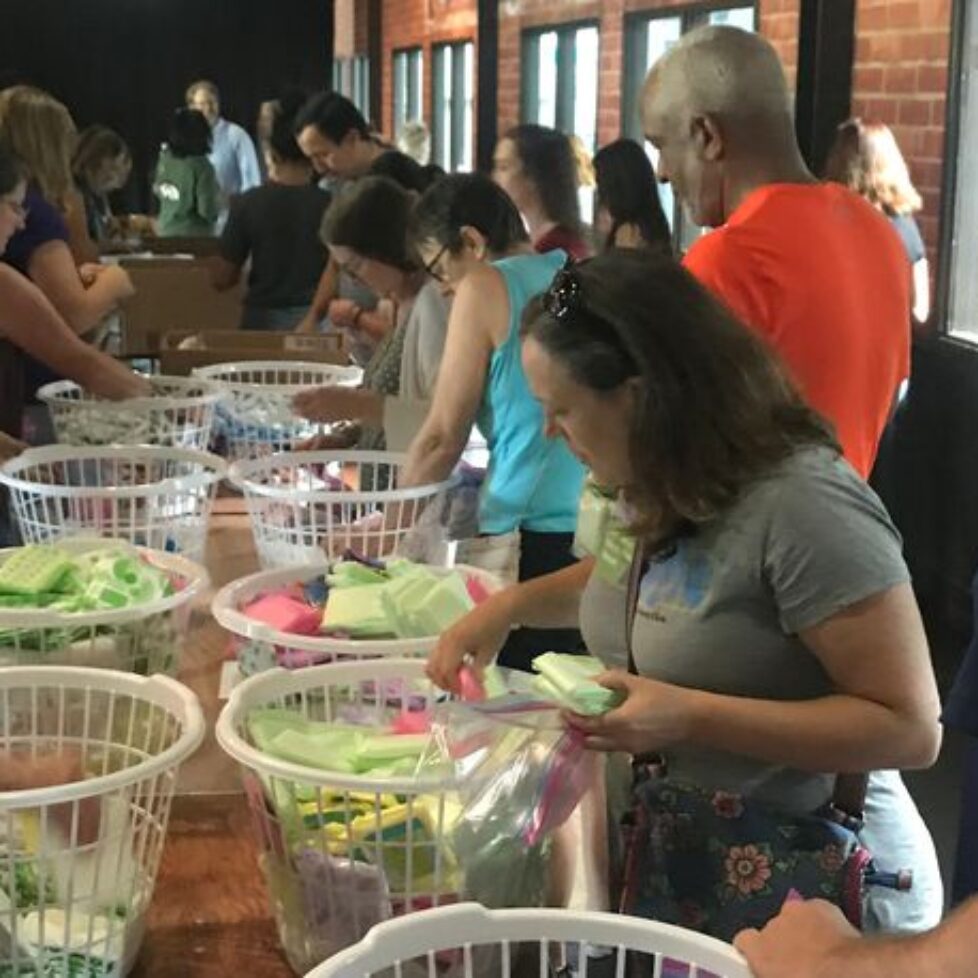
Atlanta Growing Leadership of Women (GLOW) partners with schools, communities and nonprofit organizations to pack and distribute menstrual hygiene care packages. Each Period + care package contains an assortment of pads, tampons and pantyliners, as well as feminine wipes, soap, deodorant, shampoo, a toothbrush and toothpaste.
“We want menstruators to know that they are more than their period and/or the lack of supplies thereof,” said Ashlie James, founder and executive director. “When girls don’t have access to period products, not only do they not feel protected, but it also puts their confidence, dignity and education at risk.”
Contact: Request care packages at atlantaglow.org/periodplus.
All three of these criteria must be met to be eligible for a Period + kit:
● A menstruator (ages 14-40) or their parent/guardian
● A resident of Georgia
● Economically disadvantaged as demonstrated by participation in a public assistance and/or student aid program
Homeless Period Project of Atlanta
The Homeless Period Project’s Atlanta chapter collects and distributes donated period supplies to local businesses, food pantries, shelters and other nonprofits. The organization is based in Greenville, South Carolina, and has a variety of chapters across the U.S.
Contact: Email atlanta@homelessperiodproject.org for help finding supplies.
Alliance for Period Supplies
More than 120 programs partner with the Alliance for Period Supplies, which collect, warehouse and distribute period supplies in local communities. A full map of allied programs can be found at allianceforperiodsupplies.org/allied-programs.
Contact: Call or text 2-1-1 if they need to find free period supplies in their area, or visit 211.org.
Coalition Fall 2022 Summit

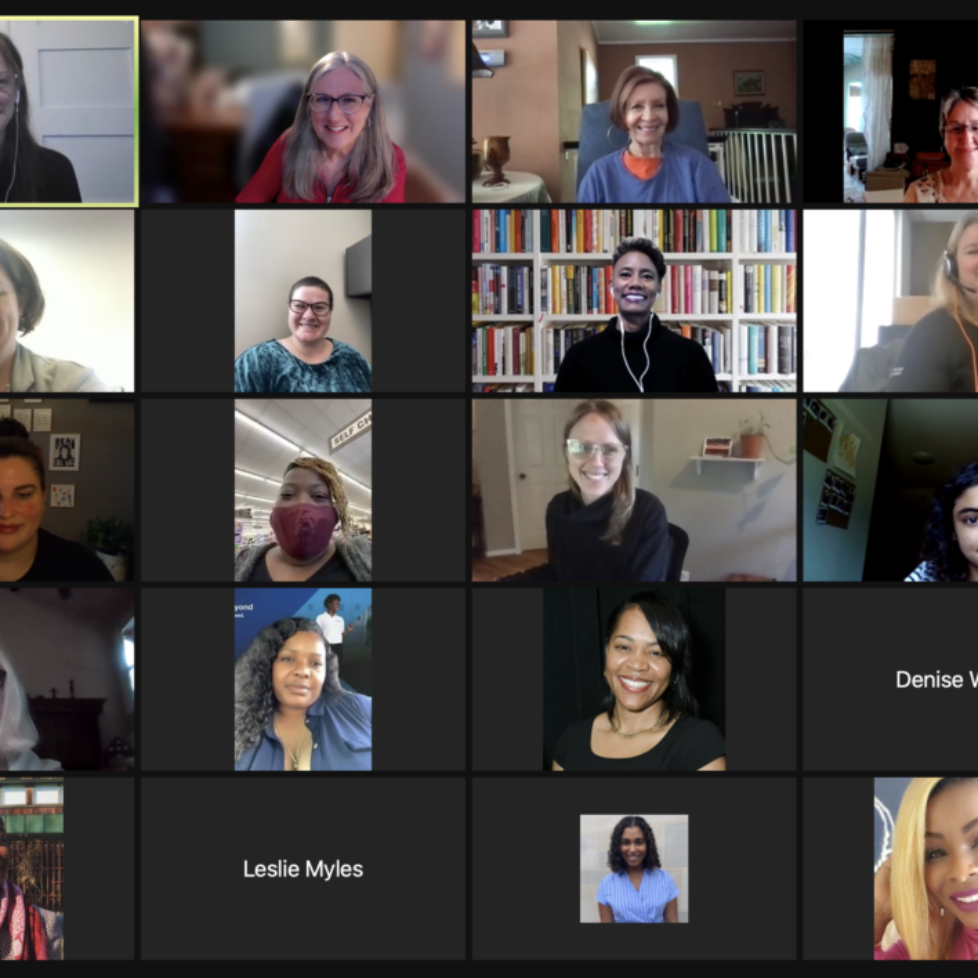
On October 27th, leaders from Georgia STOMP coalition Member Organizations convened to discuss the work of Georgia STOMP and suggest priorities for the 2022 legislative session. It was a great time for connections and new partnership collaborations. Discussions focused on communication tools, campaigns to gain the attention of legislators for elimination of the sales tax on menstrual products, and changes to the coalition’s structure in 2021. The Georgia STOMP Board will take all input from the Summit into account when setting Legislative Priorities for 2022 at its meeting on November 8th. In a follow-up email, all member organizations are asked to renew their membership status by the end of the year via a new Membership Agreement.
“Got You Covered Period” Week


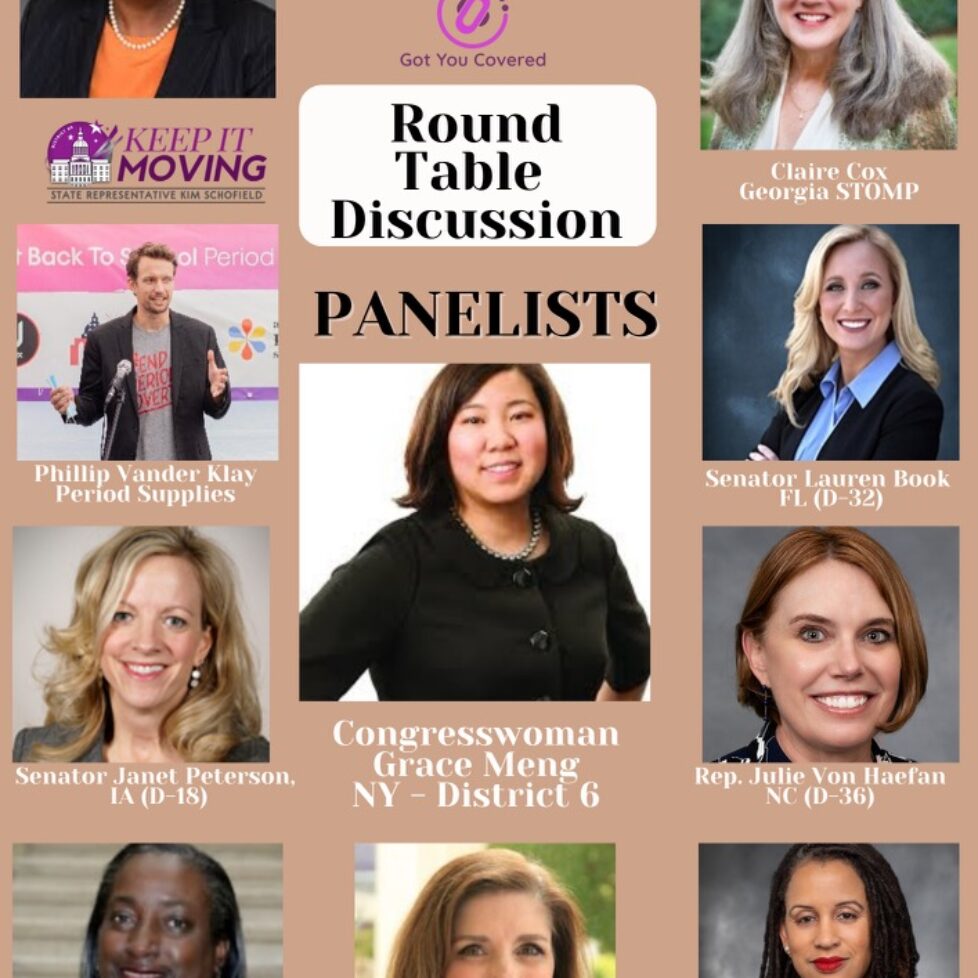
During the week of October 18th, Georgia STOMP partnered with Representative Kim Schofield for her “Got You Covered Period Week.” The week began with a round table discussion hosted by Rep. Schofield and moderated by Georgia STOMP Chair, Claire Cox. The discussion featured Congresswoman Grace Meng, sponsor of the federal “Menstrual Equity for All” Act. Legislators from Washington state, Florida, North Carolina, Louisiana, Iowa and Georgia participated in a conversation examining what has been accomplished in other states and the barriers remaining.

On Tuesday, Board Member, Aanika Eragam, represented Georgia STOMP on an Instagram Live with Rep. Schofield’s team. Aanika shared her menstruation experiences and advocacy leadership with interns from Rep. Schofield’s office. “Working with Rep. Schofield was a valuable opportunity to reach young menstruators,” Aanika said.
Wednesday, Claire Cox and Ashley Boyle attended the Facebook live with Rep. Schofield to discuss advocacy efforts in Georgia with Rep. Schofield’s team. The week concluded on Thursday with a Candid Conversation which offered an opportunity for participants to discuss their menstruation experiences across their lifespan.
“Got You Covered Period Week” was an excellent opportunity to connect with legislators dedicated to promoting menstrual equity throughout the country and for Georgia STOMP to reach a larger audience about its work. Thank you for the opportunity, Rep. Schofield!
Stella Kwon Honored With Youth Champion Award
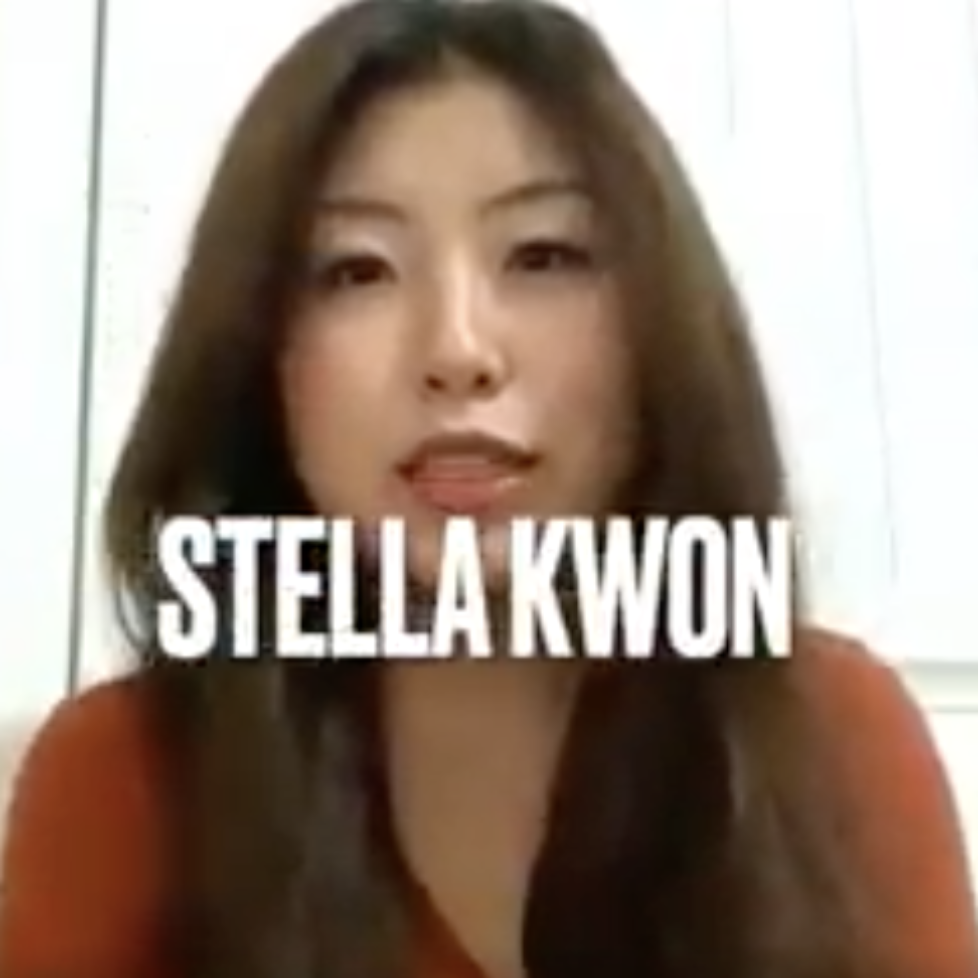
We are celebrating Stella Kwon, Georgia STOMP coalition member and president of La Lune, as she was selected for the Youth Champion Award in Education by PERIOD! She interviewed Claire Cox as a leader in the menstrual equity movement as part of her honorarium. “Some of the most pressing issues are the ones that we don’t see or don’t acknowledge,” Stella said. To learn more about Stella and the work she is doing in the menstrual equity space, visit http://www.lalunenonprofit.org.

We are Growing and Transitioning!
On Thursday, July 15th, the inaugural Board of the Georgia STOMP coalition met for its first meeting. These are exciting times as Georgia STOMP transitions from a loose coalition to a structured organization filing for 501c3 status with the IRS.
All who attended felt the excitement and common shared purpose in the meeting. Decisions were made easily, and with full input from all in attendance. Bylaws were drafted (including the nominating process for future Boards), and a monthly meeting schedule established. Elections will occur at the September Board meeting.
Take a moment and meet the 2021 Georgia STOMP Board!
Aanika Eragam – PERIOD Atlanta
Dominique Holloman – Junior League of Douglas County
Alana Intrieri Outlaw – YWCA Greater ATL
Ashlie James – Atlanta GLOW
Laura Register – Healthy Mothers, Healthy Babies Coalition of Georgia
Adele Stewart – Georgia STOMP
Claire Cox – Georgia STOMP

These leaders provide a diverse representation of Georgia STOMP member organizations geographically, demographically and in terms of the type of work in which member organizations engage
This Board will not replace the critical and directional conversations that happen around the table at Georgia STOMP’s biannual summits each Fall and Spring, to which all member organization leaders are invited!
If you have any feedback or suggestions for the new Board, we would love to hear from you!
As always, you can reach us at georgiastomp@gmail.com
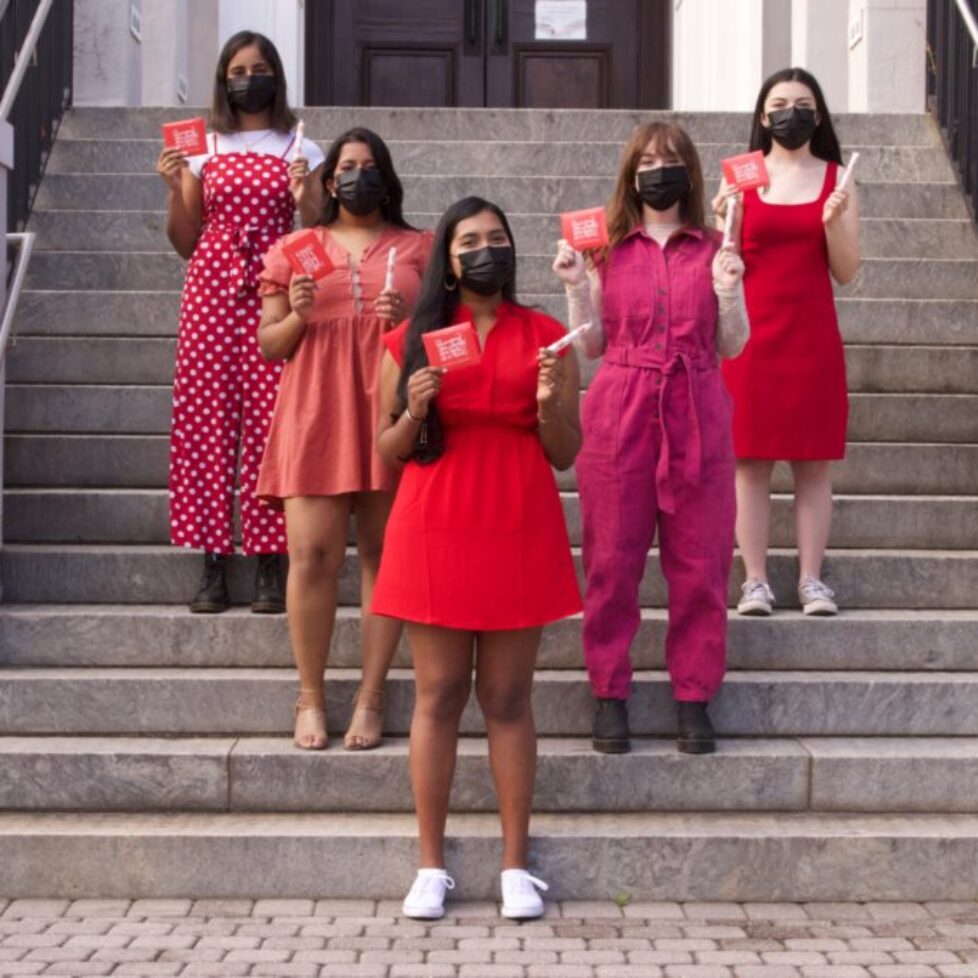
Project Red Brings Period Products to UGA

Period Product dispensers placed in two all-gender restrooms
“Several months ago, I was only making $600/month and had to choose between eating and menstrual products more than once…UGA providing free menstrual products would ensure the silently impoverished students are more easily able to reach their full academic potential.”
When you think of the tools students need to succeed in school, you might name things like a computer, notebooks, or access to study space. Most people don’t immediately consider access to period products a factor, but according to a survey conducted among UGA students, insufficient access to period products can be detrimental to a student’s education.
This survey, conducted from June-August 2020, was the first step in the formation of Project Red, an initiative to install menstrual product dispensers on UGA’s campus. Started as an offshoot of Period Project at UGA’s advocacy branch, “Project Red” became the branded name for a pilot program that provides free, biodegradable menstrual products in select all-gender UGA restrooms.
To gain a deeper understanding of the menstrual needs at UGA and in the surrounding Athens-Clarke County area, the Project Red team conducted a community needs assessment consisting of ten interviews with community members, distributed two surveys to UGA students, faculty, and staff, and assessed Project Red Instagram analytics.
Many survey respondents reported difficulties in obtaining period products and how these difficulties have affected their education. One student reported,
“I have very inconsistent and heavy periods, so oftentimes I find myself without the proper supplies when I find I need them…it is usually quite difficult to find an affordable product in times of need during or in between classes.”
Other students emphasized needs related to reproductive health that affect their menstrual cycles. For example, another student mentioned health concerns that contributed to elevated costs related to period products,
“…I dealt with quite a few menstrual issues stemming from comorbid [endometriosis] & PCOS – one time bleeding for 80 straight days…I was uninsured…Even cheap alternatives are expensive to students…”
The survey also collected responses related to everyday inconveniences that affect students’ ability to focus on their academic work,
“One time I was in class and started my period…I bled completely through my white leggings that day. My only saving grace to get me through my next classes was some wadded-up toilet paper and a friend’s jacket that I tied around my waist.”
Once the Project Red team gathered this survey data, they developed a report to pitch to UGA’s auxiliary services team to garner support for a pilot program installing period dispensers in two all-gender restrooms with funding from a $4,000 grant provided by the Office of Sustainability.
The team is working with UGA staff to expand and sustain the program, with hopes that it will be absorbed into the budget, so it is no longer reliant on grant money.
Project Red is currently creating a toolkit for other college groups looking to implement a similar program on their campus.

The Project Red team from left to right: Jaaie Varshney, Mahathi Mula, Suvitha Viswanathan, Ashley Boyle, and Maeve Breathnach
Candid Conversations!

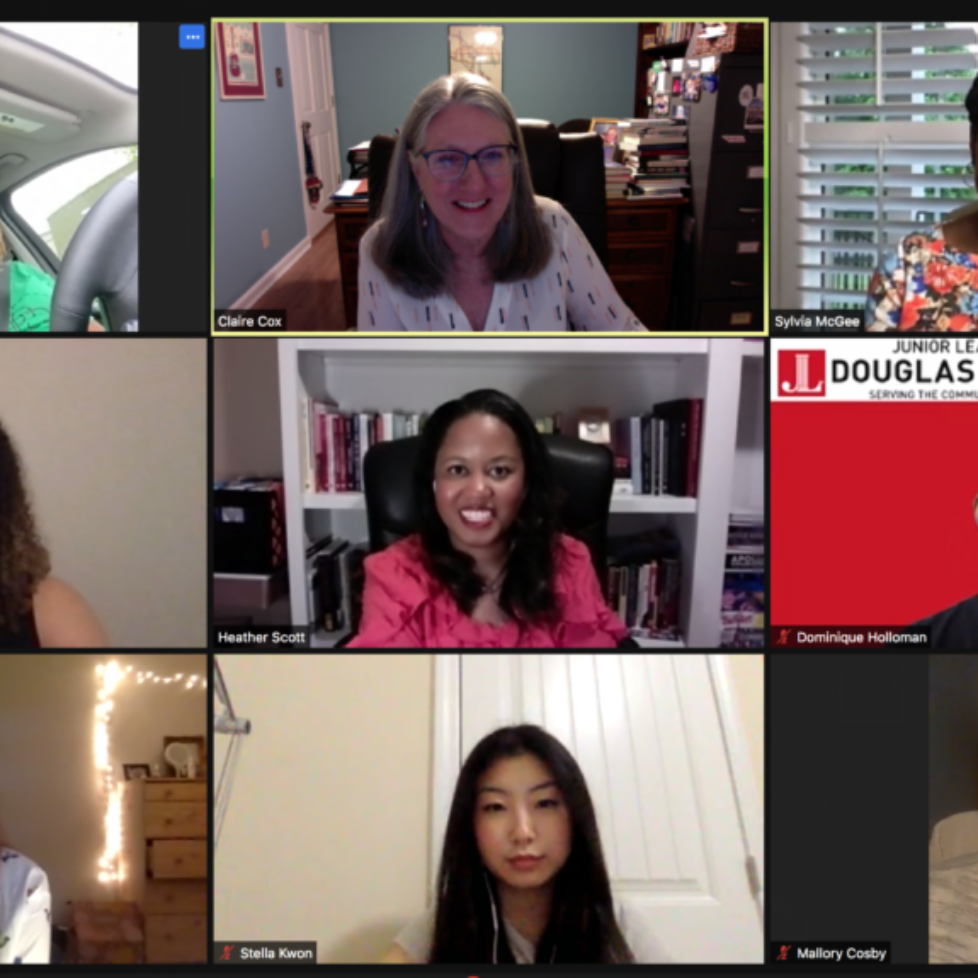
Coalition leaders came together on Tuesday, May 4, for the first of a series of Candid Conversations about menstruation. This discussion, hosted by the Junior League of Douglas County, provided a forum for participants to talk about their experiences with menstruation and reproductive health across the lifespan. The purpose was to encourage participants to speak comfortably about their experiences with menstruation in an effort to empower people to be more effective advocates for both their personal health and for menstrual equity in general. “I thought this was a unique opportunity to hear women of all ages talk about their experiences with their periods,” Ashley Boyle of Period Project at UGA said. “I heard honest conversations about menopause and reproductive health concerns that aren’t usually talked about openly.” This conversation is a model for other menstrual equity groups to host similar events. If this sounds like something your organization is interested in hosting, please email georgiastomp@gmail.com for materials and more information.
